Menu
Menu
Embroidered jewelry is very unique and attention-grabbing, while at the same time stylish and easy to personalize. It's great to wear casually, or even at formal occassions. If you do not wear necklaces, you can still use the designs as a great T-shirt embellishment! Just read on.
On this page you'll find the instructions on how to embroider and assemble the FSL Battenberg Lace Necklace and some ideas on how to embellish the necklace. Using threads of different colors and different embellishments you can achieve absolutely stunning results and make necklaces for different outfits and styles.
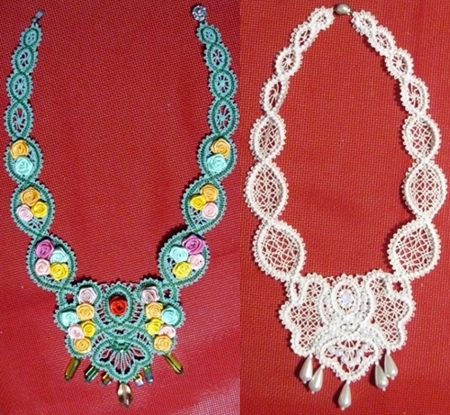
The finished length of the necklace is about 20".
Stabilizers: We recommend to use water-soluble mesh, such as Vilene. Vilene D0102 is a non woven dissolvable stabilizer which is imported into the US, is sold in large rolls and is sometimes repackaged under different brand names. Two of these brand names are Wash-Away and Aqua Magic.
Film-like water soluble stabilizers, such as Solvy, are not suitable for Free-Standing Lace embroidery.
Threads: The thinner the thread, the finer the final product will be. That is why we recommend that at least one of the threads, either in the bobbin or in the needle, should be cotton, which gives bulk to the lace and makes it look hand-made. Embroidery polyester thread will make very fine web-like lace.
Embroidery rayon thread is too soft, it does not keep its shape and very often its color fades under the influence of chemicals from the water-soluble mesh.
If you are using 50- or 60-weight cotton, you can use it both in the bobbin and in the needle. If you use 40-weight cotton thread for the needle, you can use regular polyester bobbin thread.
We used Signature machine quilting cotton thread, but similar threads from other companies should work just as well.
For the necklace, cotton thread is the best choice.
Needles: We use size 80/12 embroidery needles and 80/12 metallic needles. Our experience shows that cotton thread used with metallic needles gives less lint. The needles should be sharp, so it's advisable to change them after every project.
Most Importantly: ALWAYS make a test stitch-out of the design and wash away the stabilizer. This helps you to select the threads, needles, stabilizers and settings of your machine correctly. DO NOT embroider several designs in one hoop.
Besides watersoluble mesh and embroidery threads you will need necklace clasps and all kinds of small embellishments - beads, crystals, ribbon flowers, etc.
Step One: Hoop 2 layers of watersoluble mesh. Embroider each file of the set.
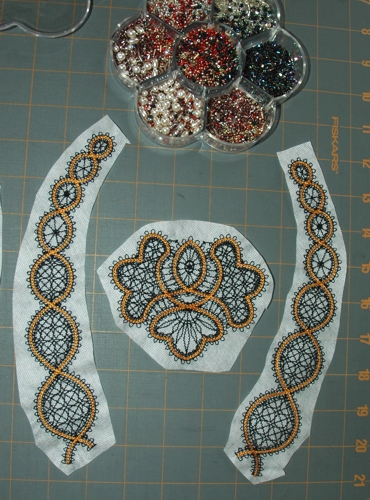
Step Two: Cut away the excess stabilizer. Rinse the remainder. Neatly spread on a towel and leave to air dry. Press with steam.
Step Three: Handstitch the parts of the lace together in the places marked in red.
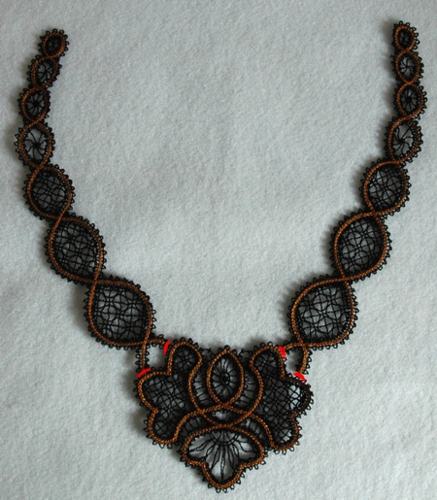
Step Four: Now unleash your creativity and make a one-of-a-kind necklace!
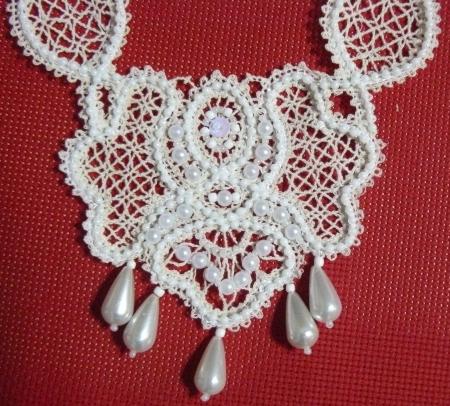
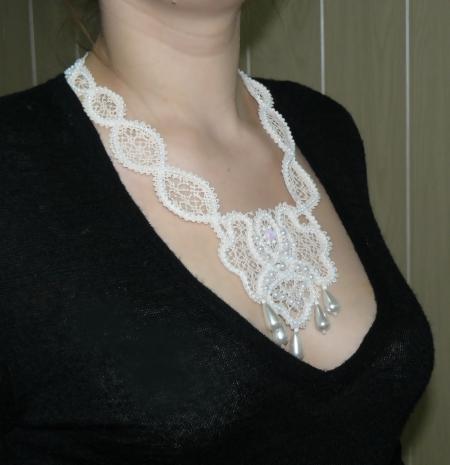
The classic white version asks for pearls. It's great for complementing a wedding gown, or for any sort of formal occasion.
We handstitched a string of seed pearls over the lines embroidered by the second color and added several larger pearls on the pendant.
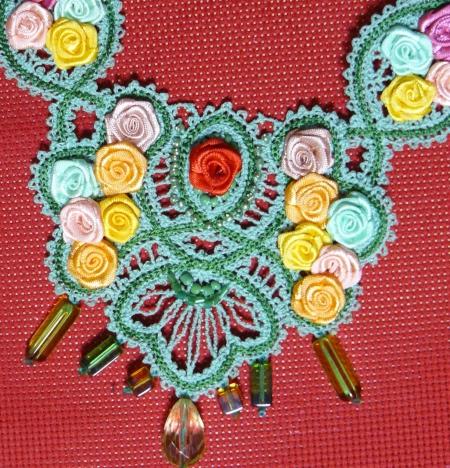
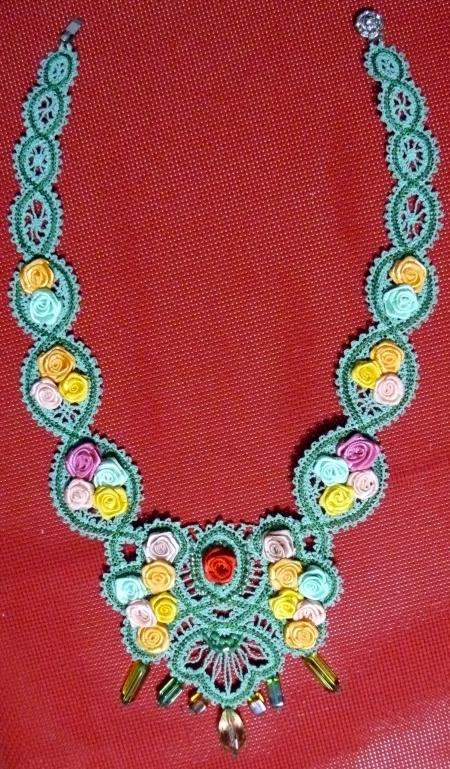
For the summer necklace we used green threads for the base, green seed beads, yellow and green glass beads and tiny ribbon roses of all colors.
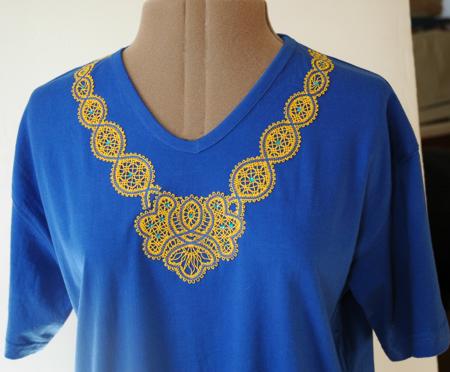
The necklace pattern can also be used to decorate a T-shirt
You can read about this at T-Shirt Embellishment with Lace Embroidery.
 Shopping Cart
 Check Out