Menu
Menu
Black-and-white cotton fabrics are very popular lately. They come with different patterns and are widely used in quilts, home decor and stylish accessories. Here we show black and white tote bags decorated with one-color embroidery.
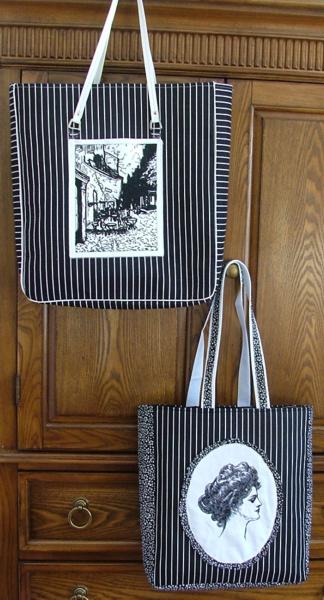
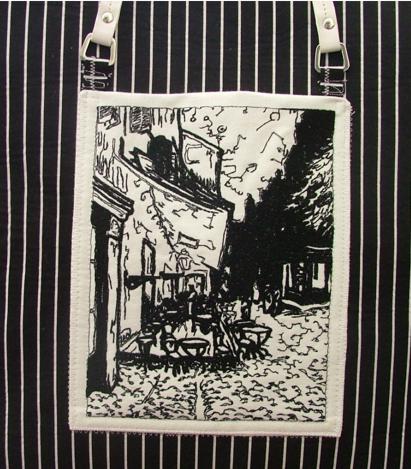
For the first project we used the design of Cafe Terrace at Night by Vincent van Gogh. Many other designs from the Redwork: Fine Art section could be used in this project.
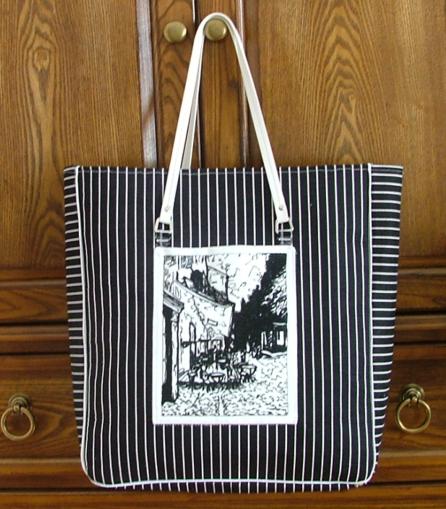
The finished size of the tote bag is about 14" x 15" x 4". We used white canvas for the embroidered pocket, black cotton with white stripes (3/4 yard) for the top and black-and-white patterned cotton fabric (1/2 yard) for the lining. You will also need a cord or piping, fusible interfacing and handles. We bought white leather handles in a Jo-Ann store.
Out of the fabric for the top, cut:
two rectangles measuring 15" x 18 1/2" (the front and back panels)
two rectangles measuring 5" x 18 1/2" (side panels)
one rectangle measuring 5" x 15" (bottom)
Out of the fabric for the lining, cut:
two rectangles measuring 16" x 19"
Our of white fabric for the pocket, cut
a rectangle about 15" x 10"
Out of fusible interfacing, cut
two rectangle measuring 15 1/2" x 15" (for the front and the back panels)
two rectangles measuring 5" x 15 1/2" (side panels)
one rectangle measuring 5" x 15" (bottom)
Note: If you want your bag soft, you can use felted quilt batting, like high loft DreamPoly, or polyester felt instead of the interfacing. To give the bag firmer sides, we recommend Pellon Peltex or Floriani one-side fusible interfacing.
If you are using felt or batting, cut it 1" larger on all sides and trim after sewing.
On the 15" x 10" white canvas rectangle, embroider the Cafe Terrace at Night by Vincent van Gogh. Use any medium-weight iron-on cut-away stabilizer. Try to position the embroidery in the center of the piece.
When the embroidery is finished, cut away the excess stabilizer and press the working piece. Fold the piece embroidery inwards, down the middle of the embroidery vertically. With the help of pins, check that the corners of the embroidery are aligned. Trim the edges to get a 7" x 9" rectangle. Pin the sides to secure in place.
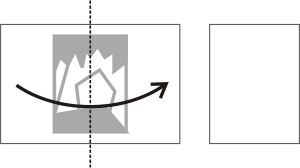
On your sewing machine, straight stitch the open long side of the piece. Seam allowance is 1/2". Press the seam open.
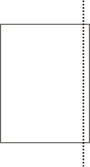
You will get a tube. Turn it right side out. Place with the embroidery up. Center the back seam and make sure that the left and right margins around the embroidery are of the same width. Press.
Tuck the upper and lower raw edges inside the tube. Be sure that the margins are of the same width. Press. Then, top-stitch them closed.
You will get a rectangle measuring 6 1/2" x 8".
Step One: Place the two fabric panels measuring 15" x 18 1/2" over the interfacing panels measuring 15" x 15 1/2". Align the bottom and the sides of the panels. The upper edge of the fabric panels should project 3" past the interfacing panels.
Fuse the fabric to the interfacing with an iron, following the manufacturer's instructions.
In the same way, fuse the fabric to the interfacing of the side panels. The upper edge on the fabric should project 3" past the interfacing.
Align all the sides on the fabric and interfacing panels of the bottom and fuse them.
Step Two: Position the embroidered pocket on the front panel 4" from the left edge, 4" from the right edge and 3 1/2" from the bottom.
Pin in place, then attach to the front panel using either zig-zag or blanket stitch.
Step Three: Position and pin the decorative cord or piping along the side and bottom edges of the front panel. The raw edge of the cord should be even with the raw edge of the fabric. It's usually 1/2" wide, which will allow you to make the seams 1/2". Using a zipper foot, stitch the cord to the fabric.
Repeat with the back panel.
Step Four: Attach the handles using fabric loops 6 1/2" from the top edge of the bag and about 4" from each side edge.
Step Five: Sew the side panels to the bottom panels, leaving 1/2" unstitched at each end of the seams. Seam allowance is 1/2".
Step Six: With the right sides together, pin the bottom and side panels to the bag's front. Using a zipper foot, stitch the parts together.
Repeat with the back panel.
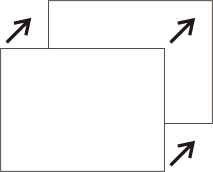
Step Seven: Place the lining rectangles face to face. Align all sides.
Cut away 2 1/2" x 2 1/2" squares in the lower corners.
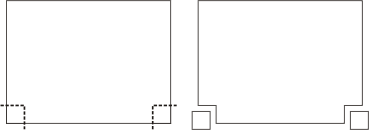
Straight stitch the shorter sides. Seam allowance is 1/2". Press the seams open.
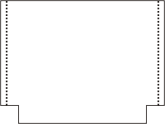
Step Eight: Put the lining over the tote. The face side of the lining should be inwards. The side seams of the lining should be in the center of the side panels of the bag. Align the upper edges of the tote and the lining. Pin them together and straight stitch on your machine. Seam allowance should be 1/4"- 1/2".
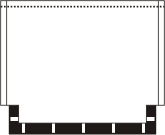
Pull the lining upwards, turning it inside out. Press the joining seam open.
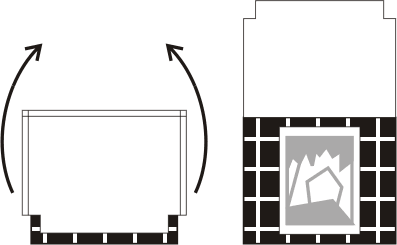
Align the raw edges of the lining. Now align the long raw edge of one panel about 1/2" from the raw edge of the second panel. Pin in place. Join the parts with a straight stitch. Seam allowance should be 1/4". Fold the wider seam allowance so that it covers the narrower one and press. Now tuck the raw edge of the wider seam allowance under and press. Top stitch to close.
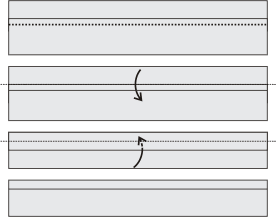
Fold the lining to align the raw edges of the cut-away corners. Tuck the raw edges inside and top-stitch in place.
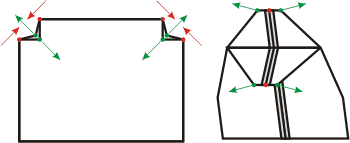
Tuck the lining inside the tote.
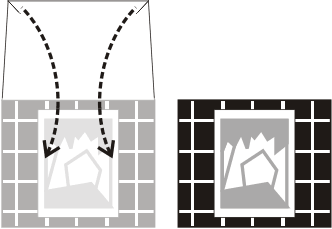
Step Nine: Top-stitch 1/4" from the upper edge of the bag all around the edge.
We hope that you liked our idea and will come up with many of your own. The second bag shown in the project, which uses the Gibson Girls designs, was made in almost the same way, with a few differences. We will describe how to make it in detail next week.
 Shopping Cart
 Check Out