Menu
Menu
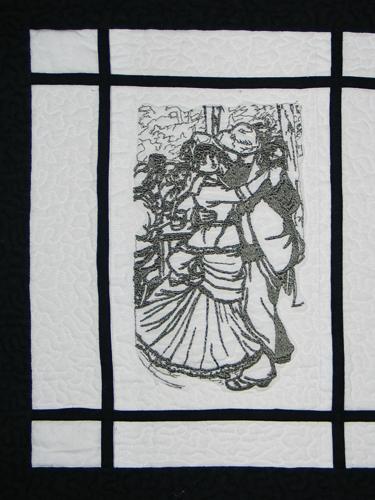
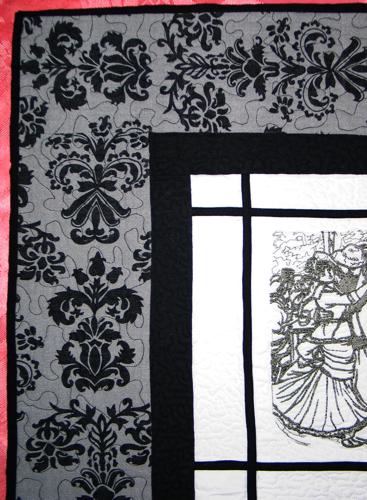
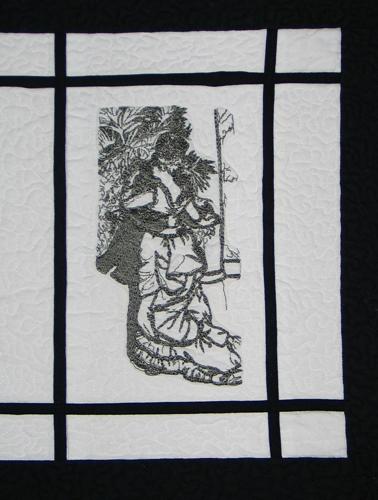
This small wall quilt features 2 designs after Pierre-Auguste Renoir's famous paintings - Dance in the Country and City Dance. The black and white fabrics enhance the artwork, and give the quilt an elegant 19th Century feel.
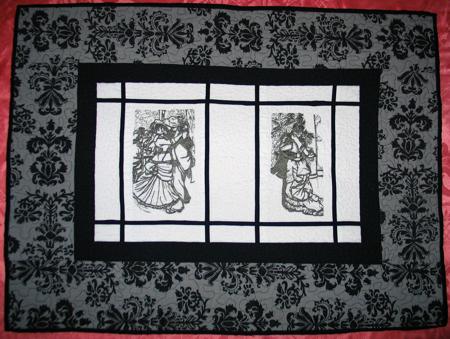
The finished size of this quilt is about 22" x 28".
We used a piece of white fabric measuring 10 1/2" x 17 1/2" for the embroidered part, 1/4 yard of black fabric for the first border and binding and about 1/2 yard of patterned dark grey fabric for the second border. We also used 2 yards of fusible bias tape 1/4" wide. You'll also need a piece of batting and backing.
Out of white fabric cut a rectangle measuring 10 1/2" x 17 1/2".
Out of black fabric cut 2 strips measuring 2 1/2" x 17 1/2", and 2 strips measuring
2 1/2" x 14 1/2". For the binding, cut 3 strips 2" wide and the length of the width of the fabric (40"-42").
Out of dark grey patterned fabric cut 2 strips measuring 4" x 14 1/2" and 2 strips measuring 4" x 29 1/2".
Cut the fusible bias tape into 2 strips 17 1/2" long and 4 strips 10 1/2" long.
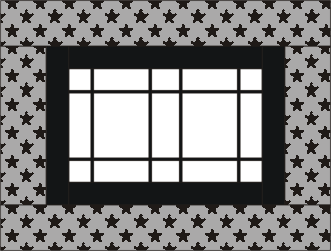
Working on your ironing board, place the white rectangle face up. Fuse the 17 1/2" strips of the bias tape 2" from the upper edge and 2" from the lower edge.

Fuse the 10 1/2" strips of the bias tape 2" from the left edge and 2" from the right edge. Fuse the remaining 2 strips 5" from the left bias tape and 5" from the right bias tape.
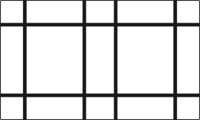
Sew the 2 1/2" x 17 1/2" black strips of the first border to the upper and lower sides of the white rectangle.
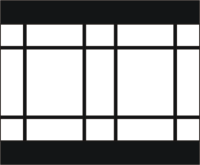
Sew the 2 1/2" x 14 1/2" black strips to the left and right sides of the white rectangle.
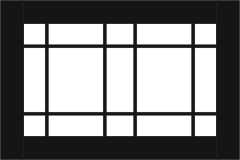
Sew the 4" x 14 1/2" dark grey strips to the left and right sides of the working piece.
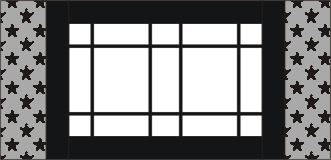
Sew the 4" x 29 1/2" to the upper and lower edges of the working piece.
Stabilize the two large white rectangles with iron-on cut-away stabilizer. Make the embroidery. Cut away the excess stabilizer.
You can also use polyester craft felt instead of the stabilizer. In this case we recommend to baste the quilt top to the felt in the ditch along the colored units. After the embroidery is finished, rip the baste and cut away the excess felt around the embroidery.
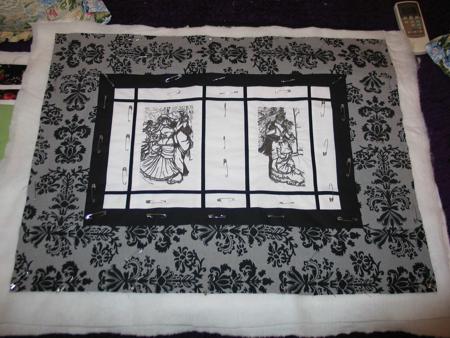
Now place the backing on a flat surface (table) face down. Cover with batting. Spread your working piece over it.
Pin all three layers together with 1" pins and start quilting. We quilted along the lines of the embroidery and made stippling all over the quilt.
After the quilting is finished, press the work with heavy steam and square the work -- all corners should be 90 degrees and opposite sides should be of the same length.
Finish the raw edges with the binding.
The quilt is ready. Enjoy!
 Shopping Cart
 Check Out